Tempo em Setúbal

Mostrar mensagens com a etiqueta Arte. Mostrar todas as mensagens

quarta-feira, 11 de abril de 2012

Raymond Candler - Imenso Adeus


27 DE JULHO DE 2011Coleccionador Vampiro

101 - Raymond Chandler: O imenso adeus


Numero: 101
Titulo: O imenso adeus
Autor: Raymond Chandler
Titulo Original: The long goodbye
Tradutor: Mário Henrique Leiria
Capa: Cândido Costa Pinto

"A primeira vez que vi o Terry Lennox estava ele perdido de bêbedo dentro de um Rolls Royce último modelo estacionado à entrada do terraço do Dancers Club. O guarda do parque trouxera o carro até à entrada e segurava a porta porque o pé esquerdo de Terry Lennox ainda balouçava no exterior, como se ele se estivesse esquecido de que o tinha. Tinha uma cara jovem, mas o cabelo era branco como papel. Pelos olhos reconhecia-se que estava bêbedo até aos cabelos, mas de resto tinha um aspecto igual ao de qualquer outro tipo simpático vestindo um «smoking» e tendo gasto mais do que devia numa casa que existe precisamente para esse fim"... 

segunda-feira, 9 de abril de 2012

Hartley Howard: A cinco horas da morte

Coleccionador Vampiro

186 - Hartley Howard: A cinco horas da morte


Numero: 186
Titulo: A cinco horas da morte
Autor: Hartley Howard
Titulo Original: Bowman on Broadway
Tradutor: Mascarenhas Barreto
Capa: Lima de Freitas

"Um destes dias, ainda acabo por largar este oficio! Não oferece o mínimo futuro. Em primeiro lugar, um tipo que acaba de festejar o trigésimo sétimo aniversário deve compreender que o trabalho e o sentimento não são compatíveis, sobretudo quando se trata deste género de trabalho; e, em segundo lugar, que, se continuo a ser sentimental, terei de aprender a tocar harpa, pois precisarei disso para responder às perguntas de São Pedro, quando me apresentar à porta do Paraíso"... 

sábado, 7 de abril de 2012

Georges Simenon: Maigret e a morte do perna-de-pau


Coleccionador Vampiro

418 - Georges Simenon: Maigret e a morte do perna-de-pau


Numero: 418
Titulo: Maigret e a morte do perna-de-pau
Autor: Georges Simenon
Titulo Original: Félicie est là
Tradutor: Paulo de Mello Barreto
Capa: A. Pedro
 
"Foi um segundo absolutamente extraordinário, visto que, provavelmente, não durou mais do que um segundo, como nos asseguram acontecer com alguns sonhos curtos que nos parecem muito mais longos.
.
Anos mais tarde, Maigret poderia mostrar o local exacto onde aquilo se produzira, o sítio do passeio onde tivera os pés, a pedra da fachada em que se projectava a sua sombra e poderia até reconstituir não só os mínimos pormenores do cenário mas também reencontrar o odor esparso, as vibrações do ar que lhe retransmitiam o sabor de uma recordação da sua infância"...

terça-feira, 3 de abril de 2012

Raymond Chandler: Perdeu-se uma mulher (Perdeu-se uma mulher)


Coleccionador Vampiro


118 - Raymond Chandler: Perdeu-se uma mulher


Numero: 118
Titulo: Perdeu-se uma mulher
Autor: Raymond Chandler
Titulo Original: Farewell, my lovely
Tradutor: Mascarenhas Barreto
Capa: Lima de Freitas

"Estava num dos quarteirões mistos da Central Avenue, que ainda não são totalmente habitados por negros. Acabara de sair de uma barbearia com três cadeiras onde uma agência de detectives supunha que um tal Dimitrios Aleidis, desertor conjugal, trabalhava. Era uma caso de pouca importância. Sua mulher dizia estar disposta a gastar algum dinheiro para conseguir fazê-lo voltar para casa.

Nunca o encontrei e Mrs. Aleidis nunca chegou a pagar-me fosse o que fosse"...

domingo, 1 de abril de 2012

Harry Carmichael: Círios para os mortos


Coleccionador Vampiro

345 - Harry Carmichael: Círios para os mortos


Numero: 345
Titulo: Círios para os mortos
Autor: Harry Carmichael
Titulo Original: Candles for the dead
Tradutor: Fernanda Pinto Rodrigues
Capa: Manuel Dias

"O voo 173, de Estocolmo, chegou a Heathrow às 20.15 h. do dia 31 de Outubro. Depois de David Breame passar pelo Controlo da Imigração e recolher a sua bagagem, faltava quase um quarto para as nove.

Só muito raramente regressava a Londres, vindo do continente, trazendo alguma coisa sujeita ao pagamento de direitos. Por isso, obedecendo ao hábito, juntou-se ao grupo de recém-chegados que metiam pela Passagem Verde, onde dois funcionários da Alfândega viam, com aparente indiferença, passar a fila de passageiros"...

quarta-feira, 27 de julho de 2011

Medieval Painting - Les Tres Riches Heures du Duc de Berry


.

Carregado por  em 22 de Jul de 2010
Les Tres Riches Heures was painted by the Lumbourg brothers , Paul , Hermann and Jean . They came from Nijmegen in what is now the Netherlands but were generally referred to as Germans . Very little is known about them ; they are believed to have been born in the late 1370s or 1380s and were born into an artistic family , their father being a wood sculptor and their uncle being an artist working variously for the French Queen and for the Duc de Bourgogne . They seem to have followed in their uncle`s footsteps and by 1402 had entered into the service of the Duc de Bourgogne as artists . By 1408 they had entered the service of Jean , Duc de Berry , one of the most notable art lovers in France . They are known to have executed several other pieces of work apart from the Tres Riches Heures but most of these , with the major exception of the Tres Belles Heures , seem to have been lost . In around February 1416 all three Limbourg brothers died before the age of thirty , apparently killed by an epidemic .The Tres Riches Heures is the classic example of a medieval book of hours . This was a collection of the text for each liturgical hour of the day . Calendars , prayers , psalms and masses for certain holy days were commonly included . The pictures in this video are from the calendar section of the Tres Riches Heures . The Limbourgs used a wide variety of colours obtained from minerals , plants or chemicals and mixed with either arabic or tragacinth gum to provide a binder for the paint . Amongst the more unusual colours they used were vert de flambe , a green obtained from crushed flowers mixed with massicot , and azur d`outreme , an ultramarine made from crushed Middle Eastern lapis-lazuli , used to paint the brilliant blues. The pictures was painted some time between 1412 and 1416 and is arguably the most beautiful part of the manuscript ; it is certainly the best known , being on of the great art treasures of France ... Music - Vox Vulgaris - Saltarello 3...........

sábado, 5 de fevereiro de 2011

Visitas Noturnas - Gil Vicente V O

A visita
1998
nanquim sobre papel
153 x 171 cm


é pesadelo de Goya
a desejada visita
Desde um abraço sonhado
desde meu calor epidérmico
deste teu forte rubor
Enfim!
vem o sono da razão
despertar-nos a carne
São dois o mesmo desejo,
é de ambos o mesmo sonho
ficando dentro de um quadro
A visita,
que se dorme sem querer,
querida,
detém-se na composição, estrutura
que então se perpetua e
fascina
pra não se concretizar.
Mas instalam-se na pele
minha excitada impressão digital
tua impressionada excitação genital
que se acabam
em águas mornas
quando nos acordamos
eu em minha cama
tu na tua
Nessa líquida fronteira
entre sono e vigília
percebemos, ainda quente,
pergunta perfumada no ar:
quem visitou quem?
.
.
[a partir de “A Visita”, nanquim sobre papel de Gil Vicente, 1998]

.
Biografia

GIL VICENTE Vasconcelos de Oliveira
Recife, 1958
Vive e trabalha em Recife

-
Estuda na Escolinha de Arte do Recife (1972-77) e nos ateliês de extensão da Universidade Federal de Pernambuco (75-77). Em 1975 recebe o 1º Prêmio do Salão dos Novos, no Museu de Arte Contemporânea de Pernambuco. Participa da fundação da Oficina Guaianases de Gravura, em 1978. No mesmo ano, realiza sua primeira mostra individual em Recife, na Galeria Abelardo Rodrigues. Estuda em Paris como bolsista do Governo Francês (80-81).
.
Recebe o Prêmio MEC/FUNARTE no Salão de Artes Plásticas de Pernambuco, em 1981. Participa do Panorama da Arte Atual Brasileira, no MAM-SP, em 1984. Integra a equipe que idealiza e publica, em 1988, o jornal Edição de Arte. Viaja aos Estados Unidos, em 1989, a convite do Governo Americano. Participa do Atelier Coletivo, em Olinda, onde faz xilogravura sob a orientação de Gilvan Samico (89-93). Em 1996 é lançado o documentário Gil Vicente - Ofício e Silêncio, de Grima Grimaldi e Paulo Macedônia, durante sua mostra Figuras/Pinturas, na Galeria Futuro 25, no Recife.
.
Sua exposição individual Desenhos é apresentada no Museu de Arte Moderna do Rio de Janeiro, em 1999, prosseguindo viajem de três anos por diversas instituições brasileiras como os museus de arte moderna da Bahia e do Recife e o MAC do Rio Grande do Sul. Inicia trabalho em fotografia, registrando pinturas e desenhos de rua, com o qual participa da III Bienal do Mercosul, em Porto Alegre, em 2001. Participa da 25ª Bienal de São Paulo, em 2002, com grandes desenhos em nanquim que depois são expostos no MAMAM, em Recife. Integra o programa de residência de artistas Faxinal das Artes, no Paraná. Realiza a individual Alheio no Centro Cultural de São Francisco, João Pessoa, no NAC/UFRN, em Natal, no Museu Metropolitano de Arte de Curitiba, na Galeria Espaço Universitário, Vitória, e no Instituto de Arte Contemporânea, em Recife (2002/03).
.
Em 2004, faz a individual Guaches recentes na Galeria Nara Roesler, em São Paulo, onde também participa da Paralela II, e integra, em Recife, a coletiva de abertura da Galeria Mariana Moura. Participa, em João Pessoa, da II Bienal do Desenho, no Espaço Cultural, e da mostra Narrativas - Desenho Contemporâneo Brasileiro, no Centro Cultural de São Francisco. Em 2005 faz parte das exposições Pornografias, na Galeria Carmem De La Guerra, em Madri, e Afinidades Eletivas, em Campinas. Em dezembro do mesmo ano, realiza a individual Inimigos na Galeria Mariana Moura, em Recife. Em 2006, mostra a série Inimigos na Casa da Ribeira, em Natal e participa da exposição Primeira pessoa, no Itaú Cultural, em São Paulo.
.
Em 2007, faz intervenção de rua com cartazes da série Inimigos na Galeria Cilindro, em Campina Grande, e realiza a mostra individual Suíte safada na Galeria Nara Roesler, em São Paulo, onde também participa do Panorama da Arte Brasileira, no Museu de Arte Moderna. Este Panorama é exposto em 2008 na Sala Alcalá 31, em Madri, cidade onde também participa da mostra Brasil Arte Contemporânea, na Arco’08. Realiza a individual de pinturas Geometria adiada, na Galeria Mariana Moura, em Recife. Em 2009 participa da coletiva Nus, na Galeria Fortes Vilaça, em São Paulo, e expõe a série Inimigos no Atelier Subterrânea, em Porto Alegre.
.

http://www.gilvicente.com.br/percurso/percurso_nota.html
.
.

.

sábado, 8 de janeiro de 2011

Emigração na expressão artística

.
.
Partida de E#migrantes - Almada Negreiros (tapeçaria)
.
.
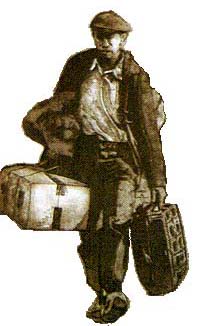
Emigrantes - Domingos Rebelo
..
Emigrantes - Carlos Silva
.
.
autocolante (25 de Abril)
.
.
.Emigrante Português - Braque
 .

.

.
Emigrante - serigrafia
.
.
Emigrante - José Malhoa
.
.
Emigraçpão - Charlot (cinema)
.
.
Navio de Emigrantes - Lasar Degall
.
O Navio Negreiro - Castro Alves


» sinopse
O navio negreiro é um poema de Castro Alves e um dos mais conhecidos da literatura brasileira. O poema descreve com imagens e expressões terríveis a situação dos africanos arrancados de suas terras, separados de suas famílias e tratados como animais nos navios negreiros que os traziam para ser propriedade de senhores e trabalhar sob as ordens dos feitores.


Um navio negreiro.
Foi escrito em São Paulo, no ano de 1869, quando o poeta tinha vinte e dois anos de idade, e quase vinte anos depois da promulgação da Lei Eusébio de Queirós, que proibiu o tráfico de escravos, em 4 de setembro de 1850. A proibição, no entanto, não vingou de todo, o que levou Castro Alves a se empenhar na denúncia da miséria a que eram submetidos os africanos na cruel travessia oceânica. É preciso lembrar que, em média, menos da metade dos escravos embarcados nos navios negreiros completavam a viagem com vida. O navio negreiro é composto de seis partes, e alterna métricas variadas para obter o efeito rítmico mais adequado a cada situação retratada no poema.
.
Prólogo
I
Stamos em pleno mar... Doudo no espaço Brinca o luar — dourada borboleta; E as vagas após ele correm... cansam Como turba de infantes inquieta.
Stamos em pleno mar... Do firmamento Os astros saltam como espumas de ouro... O mar em troca acende as ardentias, — Constelações do líquido tesouro...
Stamos em pleno mar... Dois infinitos Ali se estreitam num abraço insano, Azuis, dourados, plácidos, sublimes... Qual dos dous é o céu? qual o oceano?...
Stamos em pleno mar. . . Abrindo as velas Ao quente arfar das virações marinhas, Veleiro brigue corre à flor dos mares, Como roçam na vaga as andorinhas...
Donde vem? onde vai? Das naus errantes Quem sabe o rumo se é tão grande o espaço? Neste saara os corcéis o pó levantam, Galopam, voam, mas não deixam traço.
 
.
http://livrosgratis.net/download/2373/o-navio-negreiro-castro-alves.html
.
.
Migrantes - Portinari
.
.
.
Navio Negreiro - Rugendas
.
..
Transporte de escravos num navio negreiro
.

segunda-feira, 3 de maio de 2010

Those were the days (1) - 5 interpretações


.
.
BobsArtGallery 15 de Fevereiro de 2009 — Those were the days ( The original Russian song )
.
American singer/songwriter Gene Raskin is best known for transforming a traditional Russian folk melody into "Those Were the Days," an international blockbuster for Welsh vocalist Mary Hopkin in 1968.

 
.
.

.
.
  krisfaun 22 de Maio de 2008 — I'm uploading my copy of this song, because this one is less than 5 minutes. I've looked up this song on youtube, and most of them are at 5 minutes. I'm thinking I got a shorter version, or maybe it's not even mary hopkin.if someone knows the answer, please let me know. thanks! i still love this song for what it's worth.


Those were the days by Mary Hopkin
Paintings by Edward Hopper

Those Were The Days
(Gene Raskin / RussianTraditional)
Album:  Post Card

Once upon a time, there was a tavern
Where we used to raise a glass or two.
Remember how we laughed away the hours,
Think of all the great things we would do?

Chorus:
Those were the days, my friend!
We thought they'd never end.
We'd sing and dance forever and a day.
We'd live the life we'd choose.
We'd fight and never lose.
For we were young and sure to have our way!
Di di di di…

Then, the busy years went rushing by us.
We lost our starry notions on the way.
If, by chance, I'd see you in the tavern,
We'd smile at one another and we'd say,

Those were the days, my friend!
We thought they'd never end.
We'd sing and dance forever and a day.
We'd live the life we'd choose.
We'd fight and never lose.
Those were the days, oh yes those were the days!
Di di di di…

Just tonight, I stood before the tavern.
Nothing seemed the way it used to be.
In the glass, I saw a strange reflection.
Was that lonely woman really me?

Those were the days, my friend
We thought they'd never end
We'd sing and dance forever and a day
We'd live the life we'd choose
We'd fight and never lose
Those were the days, oh yes those were the days!
Di di di di…

Through the door, there came familiar laughter.
I saw your face and heard you call my name.
Oh my friend, we're older but no wiser,
For in our hearts, the dreams are still the same.

Those were the days, my friend!
We thought they'd never end.
We'd sing and dance forever and a day.
We'd live the life we'd choose.
We'd fight and never lose.
Those were the days, oh yes those were the days!
Di di di di…  [big finish!]
.
.
http://www.lyricsbox.com/mary-hopkin-lyrics-those-were-the-days-4p7dhmn.html
. 


.
BenmanMusic 26 de Janeiro de 2009 — Slovene mezzo Manca Izmajlova sings a new arrangment of the Russian romance. The new arrangment was written by Slavko Avsenik jr, the song Dorogoj dlinnoju - Those Were The Days is from her best-selling album Slavic Soul. It is accompanied by the Slovene National Radio Orchestra, conducted by Patrik Greblo.


.
.degnoser 6 de Março de 2009 — Le temps des fleurs - Dalida
E.Marnay/E.Raskin

Dans une taverne du vieux Londres
Où se retrouvaient des étrangers
Nos voix criblées de joies montaient de l'ombre
Et nous écoutions nos cœurs chanter

C'était le temps des fleurs
On ignorait la peur
Les lendemains avaient un goût un miel
Ton bras prenait mon bras
Ta voix suivait ma voix
On était jeunes et l'on croyait au ciel

Et puis sont venus des jours de brume
Avec des bruits étranges et des pleurs
Combien j'ai passé de nuits sans lune
À chercher la taverne dans mon cœur

Tout comme au temps des fleurs
Où l'on vivait sans peur
Où chaque jour avait un goût de miel
Ton bras prenait mon bras
Ta voix suivait ma voix
On était jeunes et l'on croyait au ciel

Et ce soir je suis devant la porte
De la taverne où tu ne viendras plus
Et la chanson que la nuit m'apporte
Mon cœur déjà ne la connaît plus

C'était le temps des fleurs
On ignorait la peur
Les lendemains avaient un goût de miel
Ton bras prenait mon bras
Ta voix suivait ma voix
On était jeunes et l'on croyait au ciel.
.
_______
.
Ivan Rebroff - Takiyeh dni, moi drug (1968)
.


Incorporação desactivada a pedido
.
nounoudydy 28 de Fevereiro de 2008 — Impossible de compter les versions existantes de "those were the days" ou si vous préférez "le temps des fleurs". De Mary Hopkin en passant par Dalida ou Ivan Rebroff, ils l'ont tous chanté.
.

Those Were the Days (song)

From Wikipedia, the free encyclopedia

"Those Were the Days"
Single by Mary Hopkin
B-side "Turn! Turn! Turn!"
Released 30 August 1968
Format 7" single
Genre Pop
Length 5:05
Label Apple
Writer(s) Gene Raskin
Producer Paul McCartney
Mary Hopkin singles chronology

"Those Were the Days"
(1968)
"Goodbye"
(1969)
"Those Were The Days"
Single by Sandie Shaw
B-side "Make It Go"
Released 1968
Genre Pop
Label Pye
Writer(s) Gene Raskin
Sandie Shaw singles chronology
Together
(1968)
Those Were the Days
(1968)
Monsieur Dupont
(1969)
For other uses, see Those Were the Days.
"Those Were the Days" is a song credited to Gene Raskin, who put English lyrics to the Russian song "Dorogoi dlinnoyu" ("Дорогой длинною", lit. "By the long road"), written by Boris Fomin (1900-1948) with words by the poet Konstantin Podrevskii. It deals with reminiscence upon youth and romantic idealism. The Georgian Tamara Tsereteli (1900-1968) in 1925[1] and Alexander Vertinsky in 1926[2] made what were probably the earliest recordings of the song. However, it is best remembered for Mary Hopkin's 1968 recording, which was a top-ten hit in both the U.S. and the U.K.

Contents


History

Gene Raskin frequented the White Horse Tavern in New York's Greenwich Village the 1960s and the song lamented the passing of the golden folk days of Dylan, Paxton, Ochs, and The Clancy Brothers & Tommy Makem.
.
Although the song was popularized in the early 1960s by The Limeliters, Welsh singer Mary Hopkin did the best known recording. It was released on 30 August 1968, shortly after Hopkin was signed to the Beatles' newly created Apple label. Hopkin's recording was produced by Paul McCartney and became a #1 hit in the UK singles chart, and reached #2 in the US. The tune topped the Billboard Easy Listening survey.
.
Paul McCartney, who produced the session, also recorded Hopkin singing "Those Were The Days" in four other languages for release in their respective countries:
  • In Spain, Que Tiempo Tan Feliz,
  • In West Germany, An jenem Tag,
  • In Italy, Quelli Erano Giorni,
  • In France, Le temps des fleurs.
The UK and the USA had the B-side, "Turn! Turn! Turn!" which was written by Pete SeegerEcclesiastes), which had been a U.S. #1 hit for The Byrds (but largely taken from the book of in 1965.
.
"Those Were the Days" was catalogue number Apple 2 (APPLE 1 designation had been intended for the Beatles single "Hey Jude").
.
Hopkin's version was released on the back of her success on the television show Opportunity Knocks and around the time of its release popular singer Sandie Shaw was also asked to record the song by her management, feeling that it should be done by a "real" singer. Shaw's version was released as a single but did not beat the success of Hopkin's version.
.
In the mid 1970s, after Hopkin's contract with Apple ended, "Those Were the Days" and "Goodbye" were re-recorded with producer Tony Visconti. Only these re-recorded versions can be found on music compilation discs because Apple never allows its original recordings to be used.
.
In 2005, Dolly Parton released a cover of "Those Were the Days," which featured backing vocals by Mary Hopkin. That year, the song became the title track of Dolly Parton's album with the same name.

Other cover versions

  • 1962 - The Limeliters
  • 1967 - Engelbert Humperdinck covers the song on the B-side of his 1967 album "The Last Waltz".
  • 1968 - The French version of the song, "Le temps des fleurs," was popularized by the international recording star, Dalida. She also recorded the song in Italian and German.
  • 1968 - The international recording star Vicky Leandros recorded the French version "Le temps des fleurs" and had a huge hit in Japan, Canada, and Greece with this song.
  • 1968 - Halina Kunicka - To były piękne dni (" Those were a beautiful days " in Polish)
  • 1968 - Violetta Villas - Znowu Ciebie mam (in Polish). Her version caused controversy in Poland as Villas used lyrics she ordered from a songwriter and has re-written them without permission for the recording. As she wasn't happy with this song she wrote new lyrics herself in the 70s and performed this song under a new title "Miłością znów żyję" to this day.
  • Mary Hopkin and Sandie Shaw also sang the song in French, as well as in Italian, SpanishGerman. Both Shaw's and Hopkin's versions were released roughly around the same time, as a sort of competition between the two, to see whose single would fare better with the public. When Hopkin's album, Postcard, was re-released on CD, the Spanish and Italian versions of the songs appeared as bonus tracks. Sandie Shaw has had all of her versions re-released on separate CDs, split up by language. and
  • 1968 - Gigliola Cinquetti covered the song in Italian ("Quelli erano i giorni", with Italian lyrics by Claudo Daiano) and Spanish.
  • 1968 - Päivi Paunu covered the song in Finnish. Followed by eight other covers in 1968-1991, before the Leningrad Cowboys.
  • 1968-1969 - Olle Bergman lyrics in Swedish, "Ja, det var då", reached Svensktoppen wirh recordings by both Lena Hansson (3 weeks) and Anita Lindblom (7 weeks).
  • 1969 - Margareta Paslaru recorded the Romanian version of Hopkin's song - "Azi vreau sa rad din nou"(Today I want to laugh again)
  • 1968 - Mira Gubik - "Rég elmúlt víg napok" (Hungarian version)
  • 1969 - The 5th Dimension covered the song in their album The Age of Aquarius.
  • 1969 - Teréz Harangozó (Hungarian version: "Azok a szép napok").
  • 1969 - Ivan Rebroff made a Russian version of the song, called "Такие дни, мой друг" (Takiyeh dni, moj drug). The song was a one-by-one-translation of the first two verses and the chorus of "Those were the days" without any rhythm and rhymes. It was found as a single and on the "Live" album Russische Party from the same year.
  • 1969 - Shuli Natan recorded a Hebrew version - "כאלה היו הימים" (ka'ele hayou hayamim), to lyrics translated by Mickey Hartby. Later on, Avi Toledano made another Hebrew cover of the song.
  • 1969 - Ryoko Moriyama and Akemi Hirokawa sung Japanese version of the song, called "Kanashiki Tenshi (悲しき天使)."
  • 196? - Nani Bregvadze (Russian, Original Text, USSR)
  • 1969 - Alexandra (Germany)
  • 1970 - Teresa Teng (Taiwan) sung Traditional Chinese version of the song, called "往日的時光."
  • 197? - Irena Kohont, slovenian singer, made a Slovenian version of the song, named "To so bili dnevi". In the same year, the music video was created for this version.
  • 197? - Ahmad Zahir, Afghan singer, made a Dari version of the song, called "Zeba Negaram"
  • 1976 - Zoi Kouroukli made popular the Greek version of the song, called "Χαμένα Όνειρα (Khamena Oneira)", literally meaning "Lost Dreams", although the Greek version, under the above title, was first performed by Leo Leandros in 1968. The Greek lyrics were by Thanasis Tsongas in 1968.
  • 1989 - Hungarian band Dolly Roll covered the song in Hungarian with different lyrics from the version of Teréz Harangozó. ("Ábrándos szép napok")
  • 1990 - Demon Kogure covered "Those Were the Days" on his first solo album "Koshoku yorozu goe otoko".
  • 1990 - Flamenco duo Azúcar Moreno covered the song in Spanish as "Cuando El Amor Se Va" on their international breakthrough album Bandido.
  • 1991 - Leningrad Cowboys covered "Those Were the Days" for the Aki KaurismäkiWe Cum From Brooklyn. short film of the same name. The song was later released on their 1992 album
  • 1992 — Leningrad Cowboys and the Alexandrov Ensemble covered the song in the 1992 Total Balalaika Show and the performance was released on the live album Total Balalaika Show - Helsinki Concert later the same year.
  • 1994 - Cara Jones covered "Those Were the Days" on her debut album Different Skies. Also, Ground Zero covered "Those Were the Days" on their album Plays Standards.
  • 1994 - The Croatian group Vatrogasci (Firefighters) made a parody of this song, translating it into Croatian (naming it "Ajnc, cvaj draj") and making it in turbofolk arrangement.
  • 1995 - The Irish folk group The Clancy Brothers & Robbie O'Connell recorded this song on their album "Older but No Wiser". The title of the album comes from the last verse of the song.
  • 1998 - The German version of the song, "An jenem Tag", was popularized by the international top star Karel Gott on his best of triple album Einmal um die ganze Welt.
  • 2000 - Brings covered "Superjeile Zick"
  • 2001 - Turisas covered "Those Were the Days" on their EP "The Heart of Turisas."
  • 2004 - Dayna Kurtz covered "Those Were the Days" on her album Beautiful Yesterday. Also, New York cabaret artists Kiki & Herb included the song in their Carnegie Hall debut concert Kiki & Herb Will Die for You.
  • 2005- Folk singer, Susan Lainey, covered "Those Were The Days" in her self titled album. The song would later be selected in October 2006 by the internationally aired #1 television show "Nip/Tuck"; for a scene in Season 3 Episode 4.
  • 2005 - Although not exactly a cover, 50 Cent used an electric guitar version of the melody of "Those Were the Days" in his "When It Rains, It Pours". Also, 2005 was the year Dolly Parton covered "Those Were the Days". Parton's recording featured guest vocals by Hopkin.
  • 2005 - The Hungarian violinist Jozsef Lendvay covered this song on his Echo Klassik CD Lendvay & Friends.
  • 2006 - Il Folklorista covered "Those Were the Days". Il Folklorista is a project by Gigi D'Agostino and Luca Noise.
  • 2006 - "Those Were the Days" was converted to a chant by Carsi,a supporter group of Besiktas JK, Istanbul. It is named as "Opera for Fener" and teases with Fenerbahce, another Istanbul team. The video of chant broadcasts on Youtube and has been watched more than one million times. It is observed that even Fenerbahce supporters can not stop themselves joining the cheer when it is song by a group around. This phenomena could not be explained by sociologists yet and some substantial research is being conducted in different institutes.
  • 2007 - Slovenian singer Manca Izmajlova covered the original Russian version of the song on her album Slovanska duša (Slavic Soul).
  • 2007 - Swedish-born Greek singer Elena Paparizou covered the French version of the song, "Le temps des fleurs", which was released on her CD-single "Fos" and was featured on the bonus CD on her Yparhi Logos: Platinum Edition album.
  • 2007 - Jamaican Dancehall-Artist Shaggy covers the refrain of "Those Were the Days" in his album Intoxication.
  • 2007 - Vietnamese Singer Ngoc Ha spelade in en cover på the new Vietnamese version in Asia DVD 49 as "Nhu la thu vang".
  • 2008 - Bad Boys Blue "Heart & Soul"; Words by Gene Raskin. Music by Boris Fomin. Arranged & produced by Johann Perrier. Co-produced by Antoine Blanc.
  • 2009 - The German band RotFront covered the song in "Red Mercedes" on their album "Emigrantski Raggamuffin"

Trivia

  • The melody of the song is instantly recognizable to tens of millions of Brazilians, although most of them are probably wholly unaware of its origins or original lyrics and title; it was used for years by Brazilian TV host Silvio Santos in his Show de Calouros, a Gong Show-like talent show, with the lyrics changed to introduce the judges and host of the show.
  • On Christmas 1975, the President of Equatorial Guinea, Francisco Macías Nguema, had 150 alleged coup plotters executed to the sound of a band playing Mary Hopkin's tune Those Were the Days in a national stadium.
  • "Those Were the Days" has been adopted by supporters of UK football league club Huddersfield Town FC, as their unofficial club song. The words are modified to "Those were the days my friend we thought they'd never end - We won the league three times in row - we won the FA cup, and now we're going up - we are the Town - Oh yes we are the Town!"
  • The song also appeared in a documentary on American intellectual Norman Finkelstein entitled American Radical: The Trials of Norman Finkelstein.

See also

References

  1. ^ http://www.secondhandsongs.com/topic/34176
  2. ^ http://www.secondhandsongs.com/performance/19937

External links

Preceded by
"Hey Jude" by The Beatles
UK number one single
(Mary Hopkin version)

25 September - 30 October 1968 (6 weeks)
Succeeded by
"With a Little Help from My Friends" by Joe Cocker
Preceded by
"Koi no Kisetsu" by Pinky and the Killers
Japanese Oricon Chart number one single
(Mary Hopkin version)

January 27, 1969
Succeeded by
"Koi no Kisetsu" by Pinky and the Killers

Ilusionismo Quadrilátero

ILUSIONISMO
.

* Victor Nogueira .
.
Ele há um tempo p’ra tudo na vida
Cantando hora, minuto, segundo;
Por isso sempre existe uma saída
Enquanto nós estivermos neste mundo.
.
Há um tempo para não fenecer
Há mar, sol, luar e aves com astros
Há uma hora p'ra amar ou morrer
E tempo para não se ficar de rastos.
.
P'ra isso e' preciso sabedoria
Em busca dum bom momento, oportuno,
Com ar, bom vinho, pão e cantoria,
Sem se confundir a nuvem com Juno.
.
1991.08.11 - SETUBAL